Sunday, September 24, 2006

Where is the land going?

Pollution is not only destroying the earth, but reducing the amount of land in which to destroy. The effects of global warming are causing a significant increase in the ocean levels and a rise in land erosion on the coastlines. Due to an increase of carbon in the air, higher temperatures are causing a melting of glaciers and thermal expansion of the sea water, both contributing to the increase in sea levels. The Intergovernmental Panel on Climate Change (IPCC) monitors such potential impacts of climate change. Over the last 100 years, the sea level has risen by 10 to 25 centimeters and will continue to rise 1 meter each century if no action is taking. In a country such as Bangladesh, the increase would displace more than 13 million people alone, one and a third times the people in New York City. The rate at which the seas are rising continues to increase.

If the sea level were to rise over 4 meters, almost every coastal city in the world would be severely affected, especially in the regions of Vietnam, Bangladesh, China, India, Thailand, Philippines, Indonesia, and Egypt to name a few around the world. Several regions are already experiencing the damaging effects. One million people per year have been displaced in Bangladesh because of the loss of land along river; that's almost equivalent to displacing the city of Atlanta twice. In the case of Tuvalu, a nation that producing less carbon pollution than a small town in America, the people are close to facing a critical refugee problem. With their land totaling 10 square miles, the highest point on the mainland is 4.6 meters with an average elevation of one meter. Similar scenarios include Delaware Bay, Chesapeake Bay, the state of Florida, Cape Hatteras, and Venice.


The country of TuvaluFlood maps have now been generated to predict and forecast the global effects of rising ocean levels. The images below show the flooding after a 4 meter increase in the ocean levels.

Barcelona


Genoa


The effects of a 4 meter rise in the current ocean levels would significantly affect most coastal cities and would generate a need to consider such effects in current designs. How would a design be affected by an assumed future displacement of surrounding land or water?


Wednesday, September 20, 2006

update from the woodshop

New material for interior padding couresy of Mandi and Melissa- more details to come from them...
The polycarbonate hollow panel made it from Columbia!
Completed masonite rib!
Sanding down the masonite ribs

Had a little trouble with the CNC router and masonite
resulting in the burned edges and time delays but got it fixed this morning :)

Tuesday, September 19, 2006

fun with foam


Too much fun with the CNC router- check out Melissa's blog for process photos. We're currently 2 sheets away from being finished with the foam ribs- masonite next. Jason and Katy are in route to Columbia. I'm in love with this new material!

Monday, September 18, 2006

sumo secretary

After today I think I just need to take over the name of the sumo secretary. I spent this morning and this afternoon (and as a continuation from friday) talking to the manufacturer and distributors of polycarbonate hollow panels. It was especially amusing today to play them up against one another and even receive a concerned phone call directly from the manufacturer due to concern about the different distributors. I was able to figure out the most efficient and economic option as to how to locate just one panel of the material. It seems uncommon to just need one panel and be willing to pick up the product yourself.

BUDGET UPDATE
$468 - Foam, Masonite, and Gorilla Glue from Lowes on Sunday, September 17th
$20 - Estimated for additional hardware needed for hinge

Its exciting to see the final structure in production mode!

Thursday, September 14, 2006

manmade landscapes in Dubai

Following the megablog posting on the possibilities of manmade canals and the displacement of water, a similar study was done on manmade landscapes and the displacement of land. If water can't extend into the land, extend the land into the water. Can the displacement of land begin to have the same effect as well as directly correlate to the displacement of water?

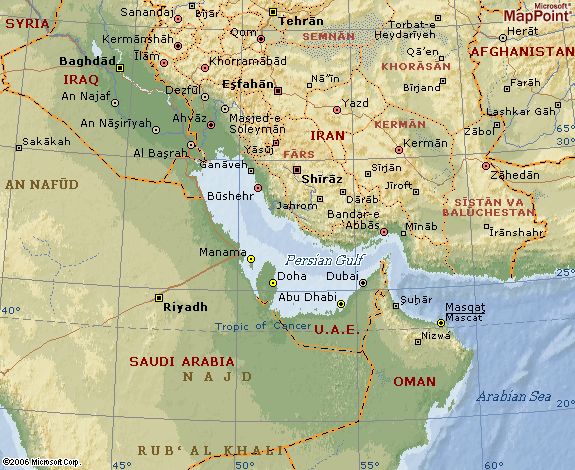
Located on the Persian Gulf coast, the city of Dubai, part of the United Arab Emigrates, is an area of vast wealth and prosperity. It is home to one of the hottest construction markets, and to some of the most known upcoming architectural projects, including SOM's design for the world's tallest tower. The lifestyle of success experienced by many in this region brings about the desire for utopia type communities. In a similar plan design as the Ocean City by Kikutake, the developer Nakheel Development has proposed a masterplan composed of fourteen developments to expand private and commercial mixed use development, increase the region's coastline, and ultimately integrate the sea with the desert.

The illustration below shows the Nakheel Development Masterplan.

Some of the major developments in the plan include:
1. The Arabian canal, an 80 km long manmade canal
2. Palm Jumeriah, contains the Trump tower and a $1.2 billion dollar hotel
3. Palm Deira, the largest mandmade island in the world
4. The World, a development of 300 islands in the shape of the continents randing from $10-$45 million per island


These two images illustrate the Palm Deira and Palm Jumeriah concepts.These projects are on the Mega scale in terms of cost and size. In the Palm Jumeriah project alone, 94 million cubic meters of sand was used, equivalent to a third of the amount of earth used for the 6700 km span of the Great Wall of China. First originating from the idea to increase beachfront, the land reclamation project and the development of the reclaimed land has doubled the shoreline of Dubai by creating 520 km of new shoreline. The amount of new shoreline is almost the same distance as the North Carolina and South Carolina coast.

The idea of land reclamation project on a large scale is becoming a reality. Other
large scale reclamation projects include Holland, Florida, and Osaka, Japan. If money is not an issue, land reclamation could greatly enhance many coastal cities in the United States allowing for growing populations and demand for waterfront property. The wealth and standard of living in the United States is reaching towards this direction. In comparison, the properties on Palm Jumeriah are 4100 sq ft houses that sell for about $1 million. Think of the possibilities with new forms or few limitations on the forms generated by land reclamation. How could this process become a significant part of urban design? Is it currently economical in places other than the Arab world?

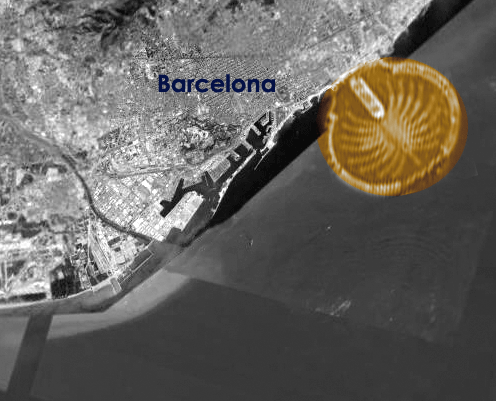
The proposal is of a significantly large scale in comparison to other cities, such as Charleston, South Carolina in the United States, and Barcelona, Spain. The illustrations below show the insertion of one of the palm islands to the existing cities.

sheet layouts

These are four layouts for the ribs on 4'x8' sheets. The first two are two different options for slicing the ribs in half to fit 2 whole ribs on each sheet. The third sheet is the outside rib cut in half, and the last sheet is the rib for the door. It is critical to maximize the use of our materials to decrease cost.

constructability

In regards to the construction of the communication, I have calculated a current budget estimate and layouts to best utilize our materials on the CNC router. I will address the budget first. The design is currently based on an approximately 30" wide structure composed of masonite ribs and foam. The masonite ribs would be 1 sheet thick or 1/4" and 3 sheets thick on the exterior ribs. The foam would be layered in increments of 5 between the ribs for a total of 3 3/4" thick. The figures would be slightly different depending on whether foam was inserted inbetween the masonite on the exterior ribs for more support. In additional, costs can be cut in half if joints are created to allow more efficient use of the materials.

Current budget with 3 sheets of masonite on either side and no rib joints:
13 sheets of masonite x $8.99 per sheet = $116.87
35 sheets of foam x $11.34 per sheet = $396.90
Estimate of glue = $50
Clear coating for foam = about $50
Dowel for hinge = $2
Side panels of acrylite acrylic- 2 48" x 48" x 1/4" sheets x $75.60 = $151.20
(best option based on research by Nicole- 1/2" are double the cost of 1/4" sheets)
TOTAL COST for Option 1 = $766.97

Current budget with 3 sheets of masonite on either side and two rib joints to allow two ribs per sheet:
10 sheets of masonite x $8.99 = $89.90
13 sheets of foam x $11.34 per sheet = $147. 42
Estimate of glue = $50
Clear coating for foam = about $50
Dowel for hinge = $2
Side panels of acrylite acrylic- 2 48" x 48" x 1/4" sheets x $75.60 = $151.20
(best option based on research by Nicole- 1/2" are double the cost of 1/4" sheets)

TOTAL COST for Option 2 = $490.52

Assuming we use option 2, $490.52 - $250 from school = $240.52 additional cost

$240.52 / 10 students = about $25 per student left to pay minus additional money from professor